I have migrated to a new site! Please find me at https://mandyfroehlich.wordpress.com/. As of April 15th, 2017 this site will no longer be updated. Thank you!
Showing posts with label innovation. Show all posts

Sunday, September 18, 2016

Change is an Opportunity to Do Something Amazing...All Around #IMMOOC

I have taught and read the Innovator's Mindset several times. I read it the first time for me, the second time for a book study for my school district's Innovation Teams, a third time through the lens of a pre-service teacher when I assigned it to my University of WI - Oshkosh students, and now again for the #IMMOOC book study. I have reflected on it repeatedly, blogged about it quite a few times, and have had/participated in multiple book studies on it, recommended it to hundreds of people. In all these discussions, the quote that seems to resonate with the most people is always:
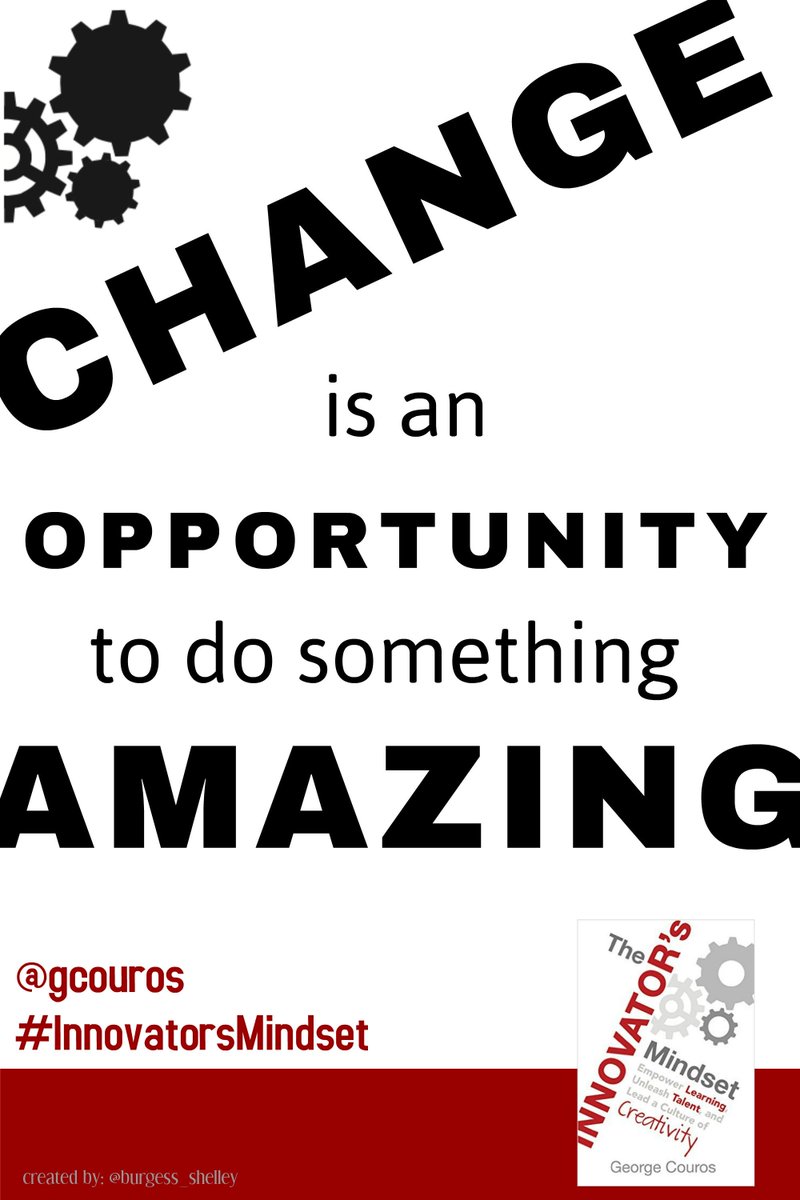
Image result for change is an opportunity to do something amazing

It's easy to apply this quote to education. Our world in EDU is constantly changing. New roles are created, new curriculum is adopted, new technologies are being introduced all the time. Our world is practically fluid, rarely do things stay the same. For some, these changes in education are expected and while not always embraced, they are at least accepted. For others, change is a difficult and stressful time. The quote resonates with people because it takes the constantly fluidity of education and puts a positive spin on it. We are perpetually changing, and with that change, you can either fight it or take it as an opportunity and run with it. In that case, it's hard to imagine anyone not choosing to be amazing.

As another semester of my UWO students started and we were discussing the beginning of the book, and one student said, "I like this quote because I think it doesn't only apply to education and our jobs, but applies to our whole lives. We are in college. We've experienced big changes in our lives when we came here, and we can choose to do something amazing with our experience." I have been reflecting on what she said since that class, and it's true. Students in college are expected to make big decisions that will affect their lives forever. I remember George telling a story in one of his keynotes about a student who said she was expected to go out and change the world when she left for college, but shortly before that she had to raise her hand to go to the bathroom when she was in high school. It's a big change when you go from the constraints of high school to the openness of college, and the change is definitely a choice and an opportunity to do something amazing.

I've experienced this myself recently with taking my new position as Director of Innovation & Technology. And as much as I love my new position, there have absolutely been moments when I've felt like the amazing part of the change might not come, or "Who am I to think that I can do something amazing at all?". Change in any form is hard, and to convince yourself to do something amazing with that change can be even harder. I think about friends who are going through tough times personally: job changes, divorce, financial trouble, and it's possible that this quote might be able to be applied to all of that. In any of these cases, including in the classroom, the work related changes, the college student, the job change, the personal issues...the amazing part of the change is going to take some work.  It's probably not going to be a lightbulb moment or some epiphany where you think, "Ahhhh...there's the amazing!" but rather something that takes diligence and commitment, hard work and motivation, which can be the hardest to muster during difficult times. I think that remembering great quotes like these help us work through those changes in order to find the amazing, which brings me back to another one of my favorite quotes, and I think these two go hand-in-hand:
Image result for not telling you easy worth it


Monday, April 25, 2016

Implementation of Innovation Teams

The 2015-2016 school year was my first year as a Technology Integrator. When I first began, both the position and I were new to the district. My understanding when I started was that some schools had "Tech Teams" and some didn't, and even the ones that did couldn't really tell me what the purpose was. Until I could get a handle on what was happening in the schools in regards to technology and innovation, I decided to hold off on beginning any kind of team.

This year, following in one of our high school's footsteps, I decided to start teams that focused on personalized learning and different innovative s, and I called our teams Innovation Teams. Currently, I am the Technology Integrator at three elementary schools, and each school has teachers and administrators that are a part of the team (one team, three schools). Teachers are on the team on a completely voluntary basis, and they are receiving no additional compensation of any kind for their extra work. Everything they do is to make themselves better for their students and profession, and I am super proud and humbled to be working with such a dedicated group of educators.

We began with a book study on what I knew to be a fantastic read in The Innovator's Mindset by George Couros. I've read the book multiple times, as well as assigned it as a class textbook for my UWO class, and I strongly felt that the mindset that the book describes was exactly what I wanted my Innovation Teams to embrace. We are almost done with the book, and there have been many ahas and that's-what-I-was-thinkings along the way. I think that the idea of being open to new experiences, the characteristics of the Innovator's Mindset, discussing an innovator's mindset versus growth mindset versus fixed mindset versus a false growth mindset has been eye opening and has set the teachers on a self-reflective journey prior to really digging in to what we wanted to accomplish.

Once the book study was underway, we also pulled up articles and research on Flexible Learning Spaces, how to create one, what to expect from students, and the benefits of implementing them. For me, I felt like Flexible Learning Spaces was a fantastic way to create teacher buy-in. Considering I was a former elementary teacher, I knew that I gravitated toward initiatives that I could both see and that would make a difference in my classroom immediately if not sooner. My thoughts were that studying and implementing Flexible Learning Spaces would hit both of these targets. In order to allow for the purchasing of flexible seating options, each principal in my three schools decided to pitch in some funds for purchasing, and each teacher put their classroom up on GoFundMe to get additional monies. There was a variety of success, but all Innovation Team teachers have made modifications to their classroom in various degrees. Some of the teachers who have made the biggest changes have plans to blog on their new classrooms and successes in our new collaborative blog: Teaching, Learning & Innovation.

As teachers began working on their classroom design and figuring out what works for their students, we also began looking at personalized learning and what it means for students to have voice and choice in their learning. We have decided to put pacing on the back-burner for now since set school schedules don't allow for as many pacing options in elementary, not that we can't get there eventually, but voice and choice are easier to implement within the elementary curriculum. Currently, we are implementing the practice of creating a rubric with standards and allowing for choice based on the rubric. Our goal is to create more authentic learning experiences for the students. We are working our way there.

In one school, we implemented our version of a student led edcamp, which we plan on doing again with some tweaks to make it more edcamp-like. We are also looking into Genius Hour and what that looks like in elementary. Each of the Innovation Team's teachers have gravitated toward a different part of what we have studied, but they are all moving forward. What has happened is that we are ending up with teachers who have become "experts" in different areas and it will allow our team to be stronger as everyone brings something different to the table.

I knew when I began the Innovation Teams that there were pockets of innovation and elements of personalized learning already going on in classrooms. I by no means think that I have brought innovative thinking to these teachers, but rather have put them together in order for them to feed off from each other and grow. I just provide them the support they need to move forward and the resources that challenge their thinking. My hope is that once others see what these teachers have accomplished (and in a relatively short period of time!) there will be a shift in thinking and we will be working toward a culture of innovation where innovation and personalized learning aren't the exception or a special occurrence, but happen everyday and will be known instead as simply learning.

Thursday, February 25, 2016

SLedCamp (Student Led edCamps)

A couple of months ago, I was introduced to the idea of Student Led edCamps. Being a Public Relations Coordinator for edCamp Oshkosh and a total believer in the power of the learning that can happen through an edCamp, I was all for trying the idea out. All I needed were some test subjects teachers who would be willing to work through what it would look like when it was implemented. Lucky for me, three of my fifth grade teachers were up for the challenge.

Fortunately, most of us had been to an edCamp and knew how sessions were grown organically by the attendees of the conference. What we didn't know was what it looked like when students took the helm, so I decided to research what others have done. I researched and researched and researched. I found blogs and articles on the benefits of Student Led edCamps and teachers who had implemented it and found it to be a wonderful way to empower kids and engage them in their learning. What I didn't find were any resources on HOW to implement such a project. I wanted perimeters (if there were any), timelines, guidelines...but I couldn't find any of that. So, we started from scratch, and my hope in posting this information would be to share what we did, what was successful, what failed, and what will be done differently next time.

Around this same time, I had just finished the book The Innovator's Mindset by George Couros. He spoke about Identity Days at his school where students and staff were able to present on a topic that they were passionate about. In one chapter he says, "Allowing students to share their interests created an environment where they felt that their voices mattered and that what they cared about mattered as well." I loved this idea, and at the first brainstorming meeting I suggested that we did a mashup of an Identity Day and a Student Led edCamp. These are the basics of what we ended up with on our planning doc:

  • Students could volunteer to lead a 20 minute session on a topic that they are passionate about. If they wanted one partner that was also passionate about the same topic, that was ok.
  • We wanted students to TRY to incorporate some sort of academic skill. For example, if a student decided to present on baking, they could also talk about fractions and how they relate to a recipe. More on this later...
  • I would offer (as the technology integrator) my services at some designated lunch recesses to assist the leaders with anything they needed as they planned such as presentation help (although presentations did not need to be done on technology - it was the choice of the student), connecting with experts in the field that they were passionate about, or planning out what they were going to say.
  • The majority of the planning and work for the SLedCamp would be done on the students' own time either at home or when they were done with work in class.
We really had no idea if the kids would go for this or not. Even though they could talk about something that really interested them, they had to do all the work on their own time, and weren't required to even participate and it wasn't graded. I think that my three teachers were skeptical that the students would take something like this on.

Our next step was to get all the fifth graders together to show them a presentation showing them an example of a teacher edCamp and explaining what we were thinking. They were instantly excited and students began signing up to lead sessions. We began with 63 total students and, after a couple of changed minds, 38 asking to lead a session either individually or with a partner. 

We gave the students two weeks to get ready for their sessions. I met with them during recess several times to try to help them in any way I could. One issue we had was that there were not enough computers available for students to work, and some didn't have computers at home to work. Our computer lab was reserved during many of the days that I had available to work with the students, so we did the best we could and the teachers tried to allow time in the computer lab.

Close to SLedCamp Day, we had all students choose the sessions that they wanted to attend. We were afraid that there would be some sessions that nobody would choose, and truthfully we weren't sure what to do if that happened. Fortunately, it did not. This was our final schedule.

The day of SLedCamp really went well. We had very few behavior issues because students were engaged in the learning. One teacher stayed in each room with the students to supervise, but students watched the clock and transitioned without much prompting. They felt in control of their SLedCamp. The Leaders were amazing. Even students who would typically not get up and present were enthusiastic. Many students were absolutely natural teachers and it was obvious that some teaching strategies were modeled for them. For example, in a drawing session, I heard the leader say, "Everyone give me a thumbs up if you're ready to move on!"
Segway Demonstration

Group Cheesecake Creating


Cupcake Selfie

He was so excited for the Drone session that he brought
his own iPad to record the presentation.


Overall, our first SLedCamp was a huge success. The students were excited about what they learned from their peers.
"It inspired me to want to learn more about technology."


Upon reflecting upon the day ourselves, we found that the next time, we wouldn't bother asking the students which session they wanted to go to and scheduling them out. I think that our worries were unfounded that some students wouldn't have attendees. Also, the next time that we have SLedCamp, our sessions are going to be more academic and possibly we will try to embrace more of the true edCamp style where the sessions are grown organically from the participants. Only about half of the students included any kind of skill into their sessions, so that was a fail on our part for not making that more clear. For the first time, this time, the way we did it was great. We created buy-in and the students said that they would not have been comfortable presenting immediately without time to prepare. Regardless, it was an awesome experience for both us as teachers to see that side of the students and the students to be given the chance to show a part of themselves that they might not have otherwise shown.

I hope this post was helpful to anyone thinking of taking something like this on. If you have any questions, please let me know!