I have migrated to a new site! Please find me at https://mandyfroehlich.wordpress.com/. As of April 15th, 2017 this site will no longer be updated. Thank you!
Showing posts with label learning experiences. Show all posts

Sunday, April 9, 2017

5 Things I've Learned in My First Year As an Admin

I still have 102 days until I have been in my administrative role for one year. I have a countdown on my phone, because like your first year of teaching, I'm assuming (and, for goodness sakes, hoping) that this is the year where I spend most of my day wondering if I'm making the right choices, and the rest of the day in a fog where I try to unravel all of the eccentricities and logistics of the position that I still don't know. Throughout this last year, I have grown and changed exponentially. The following are some of my biggest aha's so far.

Climate & culture dictates trust
No matter what kind of leader you are, when you enter a new district, the current climate and culture that the other leadership has established will dictate how teachers and students trust you. It is the difference between trust being freely given and the need to earn it. If there is a common understanding that the administration can't be trusted to support teachers effectively and rules are in place to measure compliance versus honor professionalism, a new administrator will be treated to the same skepticism and negativity as the other admins are thought of. On the flip side, if the administration has prioritized transparency, a shared vision, and supporting their staff, the administrator will most likely walk into a positive, welcoming environment. This experience has made me realize how absolutely imperative a focus on climate and culture is at every level. After all, it is much easier to move people forward when you're trusted, and it's much easier to maintain trust than it is to earn it.

Leaders must model what they want to see
Sometimes, I feel like I have a soapbox dedicated specifically to this topic, but I firmly believe that we cannot ask others to participate in activities, no matter how valuable we think they are, if we are not willing to do them ourselves. In my previous role, I had time set aside to research new technologies and ways to integrate them into the curriculum. It is much more difficult for me to do that now with my additional roles, but if I expect teachers to be researching and integrating technology it is necessary for me to do it as well. After all, if I say I don't have time to do it, that claim is doing two things:

1) Making my time seem more valuable than theirs. Why would I assume that I don't have the time and they do?
2) Negating the importance of the activity. Everyone makes time for the things they feel are important. If I don't make time, obviously it's not that important.

The same goes for other activities that we often ask of teachers: blogging, Twitter, reflecting, submitting artifacts to demonstrate our effectiveness...the list goes on and on. Teachers model for students and administration needs to model for teachers.

The best leadership is not necessarily by admins
As an administrator, if I really want change and buy-in into an initiative, I'm going to my strongest teacher leaders and asking for help. I can't do it on my own. I guarantee that the teacher leaders in our schools have so much more influence than I could ever have. Why? Because they're boots on the ground. They know what it takes to make initiatives and ideas work in the real world with real students who have real strengths and challenges. A teacher leader should never underestimate the power they have to create positive change in their district, because when it comes down to it, these people are one of the main drivers for change. And when these people feel supported by their administration, watch out! They'll stop at nothing to do what they can to make sure their students have what they need to excel.

Vision must be shared
There is this strange, fine line between complete transparency and too much information. Too much information can be overwhelming, and sometimes admin try to shield teachers from the minute decisions being made because teachers are working with students, and it's our job to support them in maintaining that focus. However, the vision for the district needs to be continually shared. I don't mean this in the way of referring back to the vision statement, even though I think that is important as well. I mean for administration to make connections between initiatives, trainings and professional development, and show teachers where all of the newness is leading. They must be given the why, which should be tightly correlated with the vision of the district. Administration should never assume that the vision is clear and that stakeholders automatically make the connections. The vision, connections between the initiatives and connections to student learning should be explicitly given. Without it, people will be left without reason as to why they do what they do, and there will be little buy-in. This is especially true when there is a lack of trust between teachers and admin.

Relationships, relationships, relationships
When I interviewed for this position, I must've said the word "relationships" 109 times. Valuing relationships has always been a strength of mine, but since taking this role, have become significantly more important as I work with more people and need to trust those around me to do their jobs. Recently, one of my IT team members gave me I one of the greatest compliments I have ever received. She told me that she enjoys coming to work. She said she has fun, enjoys her job, and gets more accomplished than she ever has before, and she credits me with creating that type of environment in our office. I nearly teared up. I love my profession. I can't imagine coming to work every day and hating what I do, so it makes me feel proud and humbled that I could create an environment where someone enjoys coming to work, and knows that I trust her to get her job done (and she consistently goes above and beyond her position). I've accomplished this by prioritizing the need to create relationships with the people who I support. I have not done this with every teacher in the district yet. But the idea of every teacher in the district understanding that I am there to support them and student learning would be a number one goal of mine, and I can do that through relationships and building trust.

Part of cultivating relationships is also the ability to have both difficult conversations and give useful feedback. I need to know that the people I work with trust that I will give them feedback and support them in growing in an area, as well as trust that I will take the feedback that they give me and reflect and change. By having an established relationship, feedback can go both ways as an opportunity for growth instead of one recipient feeling attacked or ashamed.

I am asked on a regular basis how I like my job. There are days that I miss teaching. There are other days when I miss my technology integrator role where I could focus on teachers and students. I'm not going to lie, budget is not my thing. But, I love my profession. When I turn the corner and realize that a teacher finally trusts me, or when I see a teacher trying something new in their classroom and then talking excitedly about how engaged his/her students were, or when a co-worker comes to me with a problem and trusts my opinion...it's those moments when I think that I could finally be seen as a leader AND an admin that remind me why I love doing what I do.

Image result for leadership in schools quote

Wednesday, March 22, 2017

Public Edu vs Private Sector: Is leadership universal?

I truly believe that as my position has changed and I have moved into administration, the more people I serve in my role. I have been absolutely blessed in having the best mentor a leader could ask for in Dave Gundlach and the other leaders who have unofficially taken me under their wing to show me the way to best support the people I work for. Proof positive that no matter how "high" you think you are on the ladder, everyone needs a mentor.

Sometimes, however, I learn just as much about leadership from people and stories that I might not want to emulate. For example, I was speaking with someone recently who works at a paper converting company. They explained that there is a supervisor who is, what I would describe as, the quintessential manager and seems to exhibit few leadership qualities.

There are two shifts at this particular plant. The first shift was performing very well. They consistently maintained producing at 115-120%. The second shift was performing significantly under 100%. In an effort to drive production in the second shift, the entire plant was brought in and sternly told they weren't working at their full capacity, and the expectation was 100% every week.

What happened? Second shift continues to be below 100%. First shift has dropped to 100%.

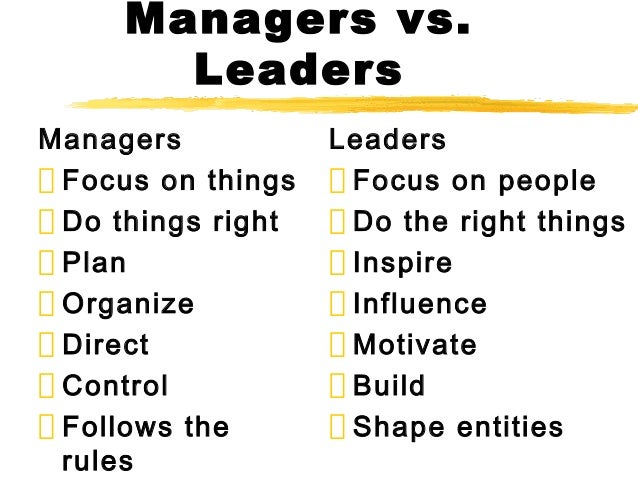
Image result for leader versus manager


So, the question is: how could the manager have handled the situation differently in order to keep the first shift working at above 100%, and also raise the performance of the second shift?

This scenario isn't much different than the one that I gave in a previous blog post about Teacher Evaluation Systems. Many times, initiatives seem to be implemented to bring up our teachers who need additional assistance to be successful, but in demanding additional compliance in order to help these teachers, we put a ceiling on our highest flyers. In the case of the paper converting company and education, I think that the people operating at a lower level would benefit from leadership that provides them with peer coaching, additional training, and is willing to have the difficult conversations with people who need them individually. For example, both the attitudes and the conversation would have looked much different if the manager would have said, "First shift has been doing a phenomenal job of producing at 120%. Clearly, they are doing something that is making them highly successful. We would like to see what that is, and would like to give everyone the opportunity to learn from one another. We are going to alter our schedules slightly for the next few weeks to allow for collaboration between first and second shift."

In the discussion with the employee, I also discovered that training time had been cut from a minimum of one month on a new machine down to two weeks or less but there was no adjustment to the expectation of efficiency. Often times in edu, initiatives are implemented with little training or professional development. We know this with students...practice makes perfect. As leaders, if we cut back on training and professional development, we need to reevaluate how effective we want teachers to be. If we want them to be highly effective (duh) then we need to allow them the opportunity to learn and grow and give them time to practice those skills.

We often talk about public education and the private sector as being two completely different entities, and I would agree that it is different when your "products" are children and their futures versus a ream of paper. However, I think that it is worth noticing that there are similarities as well. Leaders and managers possess similar characteristics wherever they are, whether they work in either sector. Their capabilities, strengths and weaknesses can be the catalyst for positive change or the push that plummets productivity.

Wednesday, February 22, 2017

Be the Change

I had one of those days yesterday where you question how effective you truly are at your job. When you realize that thinking you're on the same page as somebody and actually being there are two different things. I tried to reflect on my leadership skills to see where it is that I'm lacking...places where I could make change in order to be the leader I need to in order to move people forward. I often see the same struggle in the people around me: the technology mentor teachers that I work with and how discouraged they are when people don't show up for their professional development, or a technology integrator friend of mine who's struggling with administration right now in trying to get them to see what's really best for teachers. It's sometimes easy to get stuck when you feel like you're pulling people along instead of supporting people in their own desire to move forward. I questioned whether I had what it takes to even live in this role, and if I was able to actually dig down and find the part that told me I could, where do I go from there?

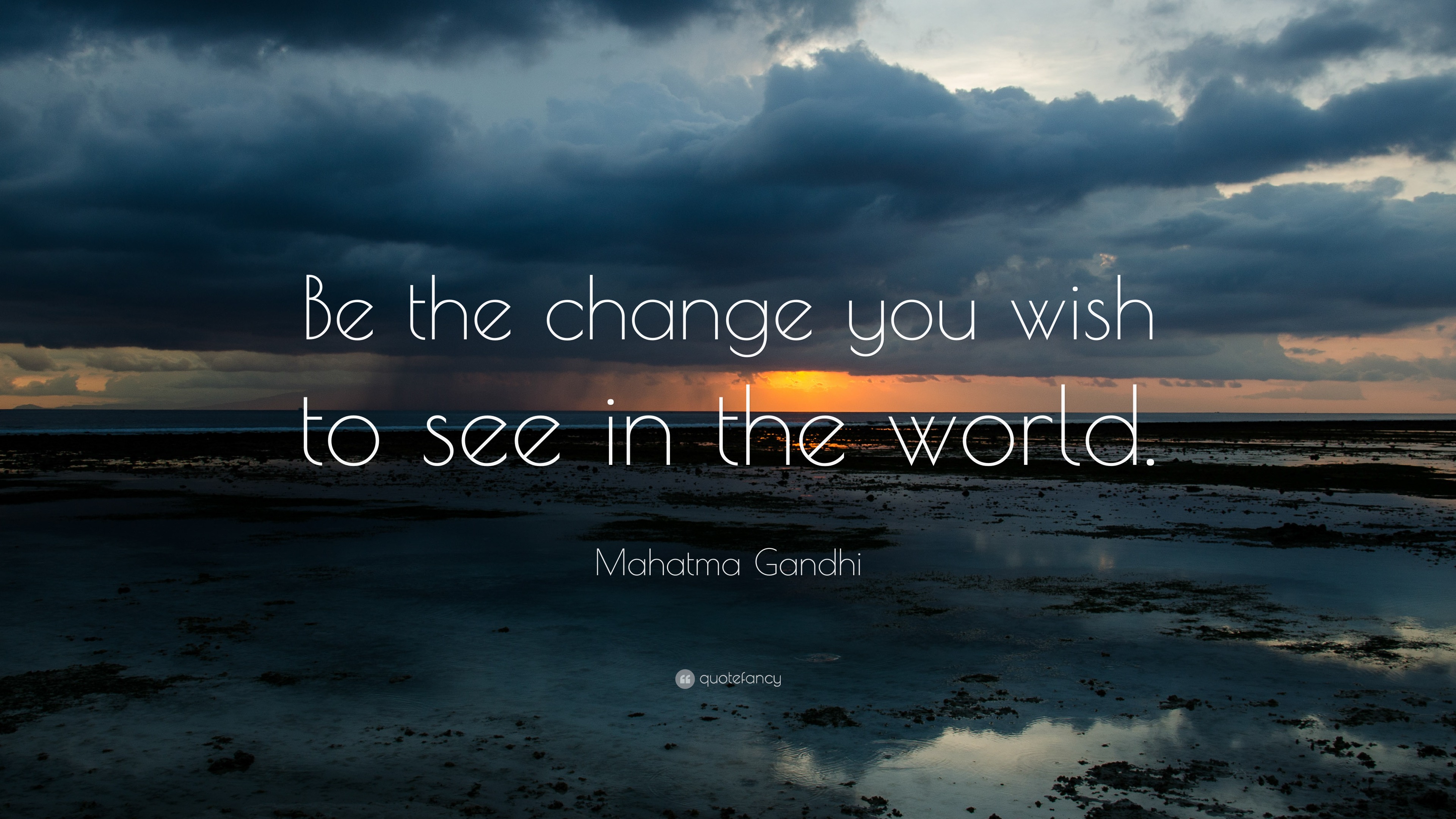
Recently, I've had several discussions about modeling the behavior we want to see. This needs to happen at all levels. If a teacher wants a student to be an effective listener, are they modeling that behavior when the students are talking to them, or are they distracted and thinking about 10 other things? If an administrator is asking a teacher to be a global collaborator, are they connecting with people on a global scale and modeling that behavior? We can't expect things out of people that we're not willing to do ourselves. After several lengthy discussions with a few members of my PLN, I came to the conclusion that I need to be the change that I want to see. If I want people be reflective and embrace growth, or if I expect people to be uncomfortable and learn, I better be willing to do those same things myself to show them that I'm walking the walk.

I can't preach change and stay stagnant myself and expect people to take me seriously.

Recently, my phenomenal mentor has challenged me to learn more about the back end of our technology department. My strength is instruction and teaching and curriculum and not networks and switches and routers. I balked when he first told me this. "I hate that stuff," I said.It made me uncomfortable because I didn't understand it. I honestly thought to myself how much of my brain power am I willing to allocate towards learning that. But, I set up some time with my network administrator and I'm slowly becoming familiar with that area. I don't particularly like it, and it makes me uncomfortable to be so unfamiliar with a large part of our department, but if I expect other people to grow and change, I need to have those same expectations for myself, especially when it's an area that I don't particularly like.

So, at a time when initiatives are plenty and I feel like there are many days where I'm not only not on the same page but possibly in a different book, I've decided to be the change that I want to see. I could give up and say that it's not possible to make change, but I'm going to choose the higher road and continue to model this attitude and behavior because in the end it's about the students and what's best for their learning, which alone is a good enough reason to make the effort.


Image result for be the change you wish to see

Tuesday, November 29, 2016

Defining Educationese & Creating a Common Language

Education has so many buzzwords at any given time. We take these words, throw them into goals that we create, revamp our mission & vision statements to include them, and expect teachers and students to meet the goals. What we often don't do is define what the words mean to the district. How the district defines any particular word that is used as a driver for learning. The term innovation is a perfect example...personalized learning is another. If we don't take time to define the educationese that we use in our goals, it's difficult to expect people to know how to meet them.

Recently, I was presenting a workshop on personalized learning. The night before, I had an idea on how I might be able to get this very idea across. I revamped my presentation, and the next day I broke the participants into groups, gave them a word that I wanted them to define and asked teachers to close their devices briefly (gasp! - I know, it was only for a bit, though) so they couldn't look up the definition. The word was Nomophobia. Teachers were asked to define the word, create a SMART goal to meet the needs for this word, and action steps on how to meet the SMART goal. The result was amazing. Teachers created very real goals and definitions. They had an idea of what the word could be by noticing that the root word "phobia" was there, similar to how we might have an idea of what a buzzword might mean. They created action steps that would be best practice for meeting any goal. They had professional development offered, students were creating content, teachers were running PLCs based on the concept. They had many activities that we see in new districtwide and schoolwide implementations every day. When all the groups finished, we looked at how they had defined the unknown word. Even though they had fantastically realistic goals and activities, all of their definitions, although similar, were incorrect. All of them had an element of truth. The groups recognized that phobia was a fear, but the root word threw them off, therefore while the plans were solid, nobody knew what the goals and activities were really accomplishing.

(Nomophobia, by the way, is the fear of being without a mobile phone. I am a self diagnosed Nomophobiac.)

Sometimes, defining a word seems like an elementary task. Sometimes, it seems like it would be obvious that all stakeholders know what a term means. Sometimes, I think deep down, we are afraid of finding out that we were the ones who didn't know what it meant. No matter the reason why, when we create goals and implement new ideas without going through this important step, we are risking complete failure because we have no common foundation to build upon.

Saturday, November 12, 2016

Made in China: New Connections

I've joked before in posts about living my entire life outside my comfort zone, but it's true. It's where I've found the most rewarding, unexpected experiences to happen that, in some cases, have changed a part of my person that would not have otherwise been affected. A few years ago, I decided to begin to say yes even when I really wanted to say no. Sometimes, that means considerable angst and anxiety, and my poor friends and family take the brunt of it as I try to work through what seems to be a complete inability to take things as they come.

When I was asked to go to China for an international forum and to visit schools in order to see if there could be the possibility of student exchanges, I was more than apprehensive. China was never a country I considered visiting, and I was concerned about some of the stories I had heard about others' experiences. However, in the true spirit of trying to say yes instead of no, I agreed to go and, in turn, began my months worth of worrying and concern about what everything would be like, and if I would do something wrong no matter how hard I tried to control my Americanism and end up tragically offending someone. My good friend, Dave Gundlach, was convinced I would cause an international incident. Possibly end up in prison. I didn't really think he was that far off.

The plan was to travel with our high school principal, Randy Hatlen, and his wife Mary. But while they had each other, I would be going alone. Alone. Another thing I don't do well at. I was concerned about this constantly. I have traveled alone many times before, so that wasn't the issue. The issue was the part of being alone in a foreign country in which I would stick out like a sore thumb. We didn't have a clear itinerary. I didn't know what to pack. I didn't know what the hotel would be like. I didn't know if my curling iron would work (gasp!). All in all, this trip would be the opposite of everything that I need in my life to feel comfortable. Lists. Plans. Checkboxes. And we were missing all of them. Then, to top it off, the first change came instantly when we arrived in China. First thing, I was separated from Randy and Mary to go to a different hotel because our itineraries changed, and I was to go alone. Alone. By myself. In China. I cried for an hour when I got to the hotel. I'm not proud of that, but I was literally past my anxiety point and had no idea what to expect next. I was trying to tell myself that I had an opportunity that I might never have again. It didn't matter. I was distraught. It was pathetic.

The next day I was exhausted. I had five hours of sleep in 48 hours and I was almost sick I was so tired. However, my first school tour changed the entire game. Changed my entire view, really. Being able to interact with kids and see them learn, even when the teaching was so different and the style was like nothing I had seen, reminded me exactly why I do what I do when I work late hours and go away from my family to conferences and workshops. The students were thrilled to see us. Literally thrilled. They would squeal if we said hello. Blush if we asked for a picture with them or gave them a compliment. One boy, red-faced, head hung and embarrassed, came up to me to give me a paper flower he had made me. He was about 12 years old. It was the highlight and turning point of my trip. Kids are kids no matter where you go. They want to learn and grow and deserve that chance. Leave it to the kids to set me straight.

From that moment on, I vowed to try to take things as they came, and that was a good choice for me because had I been looking for the most random experience ever, I would have certainly gotten what I wished for in China. Ultimately, living outside my comfort zone allowed me to have an amazing, life-changing experience. Not only did I cultivate a love for the country and its inhabitants, but I met phenomenal people from all over the world. People that create positive change for education and are truly making a difference in their educational system. I was humbled to be able to be a part of their experience. For example, my new friend Sylvia Paddock, who works with schools to improve teacher effectiveness through professional development and shared professional practice, and who shares my weird sense of humor. Or the amazing Joel Backwell from Australia, who passionately believes that creating relationships with Asian countries will allow students to have opportunities in the future that they wouldn't have otherwise, and who has quickly become a good friend of mine because he makes me smile just by chatting with him. My new friends Dan Meyers and Scott McLarty who are headmasters of a Catholic private school in San Francisco and are not only ridiculously intelligent, but also the ones who can make me laugh until I cry repeatedly with their quick wit. And finally, Petri Vuorinen from Finland and Rients VanGoudoever, who I was able to have engaging, informative conversations with about the state of education in our respective countries. Also, they might be two of the sweetest people I know. These connections have already enriched my life both personally and professionally in very unexpected ways, and I haven't even landed back on US soil yet. At one point, we were engaged with people from around the world that represented seven different countries, and an outsider might have thought that we had been friends all our lives. I don't know about anyone else, but I could use more togetherness right now...less us against them. Hopefully, we were modeling the kind of connections we would like our kids to make; the kind of future collaborations and relationships that they need to have.

I'm more sure than ever that the choice to say yes when my whole being is shouting no is one of my better life choices. It's not easy. It's difficult to consistently choose to go against your gut, especially when everyone tells you to follow it. However, had I said no to this China trip, I would have been passing up an opportunity and friendships that I now wouldn't give up for anything.


Monday, April 25, 2016

Implementation of Innovation Teams

The 2015-2016 school year was my first year as a Technology Integrator. When I first began, both the position and I were new to the district. My understanding when I started was that some schools had "Tech Teams" and some didn't, and even the ones that did couldn't really tell me what the purpose was. Until I could get a handle on what was happening in the schools in regards to technology and innovation, I decided to hold off on beginning any kind of team.

This year, following in one of our high school's footsteps, I decided to start teams that focused on personalized learning and different innovative s, and I called our teams Innovation Teams. Currently, I am the Technology Integrator at three elementary schools, and each school has teachers and administrators that are a part of the team (one team, three schools). Teachers are on the team on a completely voluntary basis, and they are receiving no additional compensation of any kind for their extra work. Everything they do is to make themselves better for their students and profession, and I am super proud and humbled to be working with such a dedicated group of educators.

We began with a book study on what I knew to be a fantastic read in The Innovator's Mindset by George Couros. I've read the book multiple times, as well as assigned it as a class textbook for my UWO class, and I strongly felt that the mindset that the book describes was exactly what I wanted my Innovation Teams to embrace. We are almost done with the book, and there have been many ahas and that's-what-I-was-thinkings along the way. I think that the idea of being open to new experiences, the characteristics of the Innovator's Mindset, discussing an innovator's mindset versus growth mindset versus fixed mindset versus a false growth mindset has been eye opening and has set the teachers on a self-reflective journey prior to really digging in to what we wanted to accomplish.

Once the book study was underway, we also pulled up articles and research on Flexible Learning Spaces, how to create one, what to expect from students, and the benefits of implementing them. For me, I felt like Flexible Learning Spaces was a fantastic way to create teacher buy-in. Considering I was a former elementary teacher, I knew that I gravitated toward initiatives that I could both see and that would make a difference in my classroom immediately if not sooner. My thoughts were that studying and implementing Flexible Learning Spaces would hit both of these targets. In order to allow for the purchasing of flexible seating options, each principal in my three schools decided to pitch in some funds for purchasing, and each teacher put their classroom up on GoFundMe to get additional monies. There was a variety of success, but all Innovation Team teachers have made modifications to their classroom in various degrees. Some of the teachers who have made the biggest changes have plans to blog on their new classrooms and successes in our new collaborative blog: Teaching, Learning & Innovation.

As teachers began working on their classroom design and figuring out what works for their students, we also began looking at personalized learning and what it means for students to have voice and choice in their learning. We have decided to put pacing on the back-burner for now since set school schedules don't allow for as many pacing options in elementary, not that we can't get there eventually, but voice and choice are easier to implement within the elementary curriculum. Currently, we are implementing the practice of creating a rubric with standards and allowing for choice based on the rubric. Our goal is to create more authentic learning experiences for the students. We are working our way there.

In one school, we implemented our version of a student led edcamp, which we plan on doing again with some tweaks to make it more edcamp-like. We are also looking into Genius Hour and what that looks like in elementary. Each of the Innovation Team's teachers have gravitated toward a different part of what we have studied, but they are all moving forward. What has happened is that we are ending up with teachers who have become "experts" in different areas and it will allow our team to be stronger as everyone brings something different to the table.

I knew when I began the Innovation Teams that there were pockets of innovation and elements of personalized learning already going on in classrooms. I by no means think that I have brought innovative thinking to these teachers, but rather have put them together in order for them to feed off from each other and grow. I just provide them the support they need to move forward and the resources that challenge their thinking. My hope is that once others see what these teachers have accomplished (and in a relatively short period of time!) there will be a shift in thinking and we will be working toward a culture of innovation where innovation and personalized learning aren't the exception or a special occurrence, but happen everyday and will be known instead as simply learning.

Thursday, February 25, 2016

SLedCamp (Student Led edCamps)

A couple of months ago, I was introduced to the idea of Student Led edCamps. Being a Public Relations Coordinator for edCamp Oshkosh and a total believer in the power of the learning that can happen through an edCamp, I was all for trying the idea out. All I needed were some test subjects teachers who would be willing to work through what it would look like when it was implemented. Lucky for me, three of my fifth grade teachers were up for the challenge.

Fortunately, most of us had been to an edCamp and knew how sessions were grown organically by the attendees of the conference. What we didn't know was what it looked like when students took the helm, so I decided to research what others have done. I researched and researched and researched. I found blogs and articles on the benefits of Student Led edCamps and teachers who had implemented it and found it to be a wonderful way to empower kids and engage them in their learning. What I didn't find were any resources on HOW to implement such a project. I wanted perimeters (if there were any), timelines, guidelines...but I couldn't find any of that. So, we started from scratch, and my hope in posting this information would be to share what we did, what was successful, what failed, and what will be done differently next time.

Around this same time, I had just finished the book The Innovator's Mindset by George Couros. He spoke about Identity Days at his school where students and staff were able to present on a topic that they were passionate about. In one chapter he says, "Allowing students to share their interests created an environment where they felt that their voices mattered and that what they cared about mattered as well." I loved this idea, and at the first brainstorming meeting I suggested that we did a mashup of an Identity Day and a Student Led edCamp. These are the basics of what we ended up with on our planning doc:

  • Students could volunteer to lead a 20 minute session on a topic that they are passionate about. If they wanted one partner that was also passionate about the same topic, that was ok.
  • We wanted students to TRY to incorporate some sort of academic skill. For example, if a student decided to present on baking, they could also talk about fractions and how they relate to a recipe. More on this later...
  • I would offer (as the technology integrator) my services at some designated lunch recesses to assist the leaders with anything they needed as they planned such as presentation help (although presentations did not need to be done on technology - it was the choice of the student), connecting with experts in the field that they were passionate about, or planning out what they were going to say.
  • The majority of the planning and work for the SLedCamp would be done on the students' own time either at home or when they were done with work in class.
We really had no idea if the kids would go for this or not. Even though they could talk about something that really interested them, they had to do all the work on their own time, and weren't required to even participate and it wasn't graded. I think that my three teachers were skeptical that the students would take something like this on.

Our next step was to get all the fifth graders together to show them a presentation showing them an example of a teacher edCamp and explaining what we were thinking. They were instantly excited and students began signing up to lead sessions. We began with 63 total students and, after a couple of changed minds, 38 asking to lead a session either individually or with a partner. 

We gave the students two weeks to get ready for their sessions. I met with them during recess several times to try to help them in any way I could. One issue we had was that there were not enough computers available for students to work, and some didn't have computers at home to work. Our computer lab was reserved during many of the days that I had available to work with the students, so we did the best we could and the teachers tried to allow time in the computer lab.

Close to SLedCamp Day, we had all students choose the sessions that they wanted to attend. We were afraid that there would be some sessions that nobody would choose, and truthfully we weren't sure what to do if that happened. Fortunately, it did not. This was our final schedule.

The day of SLedCamp really went well. We had very few behavior issues because students were engaged in the learning. One teacher stayed in each room with the students to supervise, but students watched the clock and transitioned without much prompting. They felt in control of their SLedCamp. The Leaders were amazing. Even students who would typically not get up and present were enthusiastic. Many students were absolutely natural teachers and it was obvious that some teaching strategies were modeled for them. For example, in a drawing session, I heard the leader say, "Everyone give me a thumbs up if you're ready to move on!"
Segway Demonstration

Group Cheesecake Creating


Cupcake Selfie

He was so excited for the Drone session that he brought
his own iPad to record the presentation.


Overall, our first SLedCamp was a huge success. The students were excited about what they learned from their peers.
"It inspired me to want to learn more about technology."


Upon reflecting upon the day ourselves, we found that the next time, we wouldn't bother asking the students which session they wanted to go to and scheduling them out. I think that our worries were unfounded that some students wouldn't have attendees. Also, the next time that we have SLedCamp, our sessions are going to be more academic and possibly we will try to embrace more of the true edCamp style where the sessions are grown organically from the participants. Only about half of the students included any kind of skill into their sessions, so that was a fail on our part for not making that more clear. For the first time, this time, the way we did it was great. We created buy-in and the students said that they would not have been comfortable presenting immediately without time to prepare. Regardless, it was an awesome experience for both us as teachers to see that side of the students and the students to be given the chance to show a part of themselves that they might not have otherwise shown.

I hope this post was helpful to anyone thinking of taking something like this on. If you have any questions, please let me know!