I have migrated to a new site! Please find me at https://mandyfroehlich.wordpress.com/. As of April 15th, 2017 this site will no longer be updated. Thank you!

Sunday, October 30, 2016

I'm Not a Natural

A few weeks ago, my friend George Couros wrote a blog post called No Shortage of Road and reading it made me smile because I could really relate to it. Basically, the post is about how he used to be able to run marathons and loved running, and now he doesn't and it's painful, and how sometimes it's hard to see what's behind you because you're so busy looking at the people passing you. So true, and it's inspired me to write my own blog post.

There are quite a few things that I am not a natural at. Things I have tried and they just do not come easy to me: public speaking, chemistry, and running (among others). I like to believe that I have a pretty healthy growth mindset, so it doesn't mean that I can't do these things, it just means that I need to work much harder in order to do them well. Public speaking is a prime example. As a kid, I didn't even talk to people let alone talk in front of people, so when I went to college I took every public speaking course I could find in order to conquer that fear. Now, I can speak in public and am often in front of people, so I joke and say that I live my entire life outside my comfort zone. I am not a natural public speaker, but I can speak publicly.

Running is another one of those things that I am not a natural at and I want so badly to be. Not too long ago I was in a #personalizedPD chat with my friend Jay Posick and he joked about getting back from something like a 12 mile run just for fun. JUST. FOR. FUN. And I instantly thought to myself, I could never do that and was disappointed in my meager three miles that I run (even my growth mindset needs a check sometimes).

I am not a natural runner. I say that because I need to work hard at it. I've been running for two years and there are times when I can't even run the three miles and need to walk some of it. I have asthma and sometimes that acts up, or I get those ridiculously painful cramps in my side (does anyone know how to stop that?!?). But, in looking back, I have come a long way from when I began. At first, I wouldn't even run outside because I knew I wasn't fast and I knew my running form was less than stellar. One of my favorite Friends episodes is where Phoebe tells Rachel to go outside and run even though she looks strange doing it. She says, "It doesn't matter if people are staring at you because it's just for a second and then you're gone!"


When I look back at where I started to how far I've come, I'm proud of the work I've done even though I might not be as good of a runner as others who have been running for the same amount of time. There have been times where it has been literally painful (today was one of those days), but the progress I've made has been from hard work, ignoring any feelings that people might be staring, and knowing that running is good for me mentally and physically. I'm more proud of the progress I've made in this area than I am in other activities that have come easy to me. I have failed a million times at running my entire three miles, but the times that I have run the three miles are enough of a success to keep me motivated to continue to work hard and get better.

It's important that we teach learners (adults and children) that it's not about comparing yourself to someone else, but it's about recognizing our strengths and weaknesses and and the work you do to grow in these areas. And it's not about the growth you do in relation to someone else's standard, but the progress you make according to your own standard. We can choose to use our weaknesses as excuses for why we will never be any better, or we can use them as motivation for growth and change. Just because something might not come naturally to us, doesn't mean we can't create our own type of success, and what might be considered successful to one might not be for another, but we should be celebrating those successes anyway. 

Image result for growth mindset

Friday, October 28, 2016

We Underestimate our Students

I always felt like one of my strengths as a teacher was that I always had high expectations for my students. I never lowered expectations based on a specific class or student. I expected them to grow and make progress (at their level), to enjoy learning (most of the time-we all have our days), and that each of them had strengths that made our class the community it was. Students would rise to the expectations. There was never a reason to lower them. I tried hard not to underestimate what my students could accomplish.

Yesterday, I was shopping with my daughter and I ran into one of my former pre-service teacher students from the university. She's a super girl, appropriately candid and always asked great questions. She will be a fantastic teacher. She was in one of my first classes I taught, and we all know as teachers how first classes have the ability to create a special imprint. When I asked her how her semester was going, she replied with "It's a joke". Immediately, I jumped to the conclusion that it was a lot of work, that she was swamped and struggling to keep up, therefore: a joke. When I asked her some clarifying questions, I found that by "joke" she meant that her classes were too easy. She said she was able to get all her work done at her job, hence the reason she was out shopping instead of studying like a college student should. She said that she thought her classes would be more rigorous. Instead, she barely has any work to do at all.

I'm not going to lie, I was a little shocked, but my pre-service students always continue to amaze me. It's one of the reasons that I love teaching those classes. Then I realized that I had totally underestimated her because she is a "college student" and I had fixed her with a get-out-of-as-much-work-as-possible stamp, which was wrong of me to do. In this case, she WANTS to learn. She WANTS to be a great teacher. Her classes are not providing her with enough to keep her learning, and it's irritating to her. IRRITATING TO HER that she can't get the learning she needs to be awesome (which she will be anyway because she will make it happen on her own - she'll be awesome in spite of school).

I feel like we find that same thing with teachers in the field. They have a window where they are excited and want to do what's best for their students but are not provided with the training and tools they need to move forward, so some burn out and some become cranky, but they don't start out that way.

As for the high expectations for students part, it was a good gut check for me. I was discussing this with a teacher at the beginning of school. He's a great guy, came into the teaching field from the private sector and is doing his absolute best while not yet having his teaching degree (he's working on that). When I asked him how it was going (he was first-year teacher exhausted, we can all relate) he said, "I don't know. I think I just need to lower my expectations for how my students should act". I told him absolutely not, if anything, raise them. Have faith that your students will rise to the occasion and will probably surprise you by bypassing your expectations and coming in with ideas and behaviors that are better than expected. Yet, I did the same thing with one of my students, underestimated her because she is a college student.


Image result for high expectations for students

Sunday, September 18, 2016

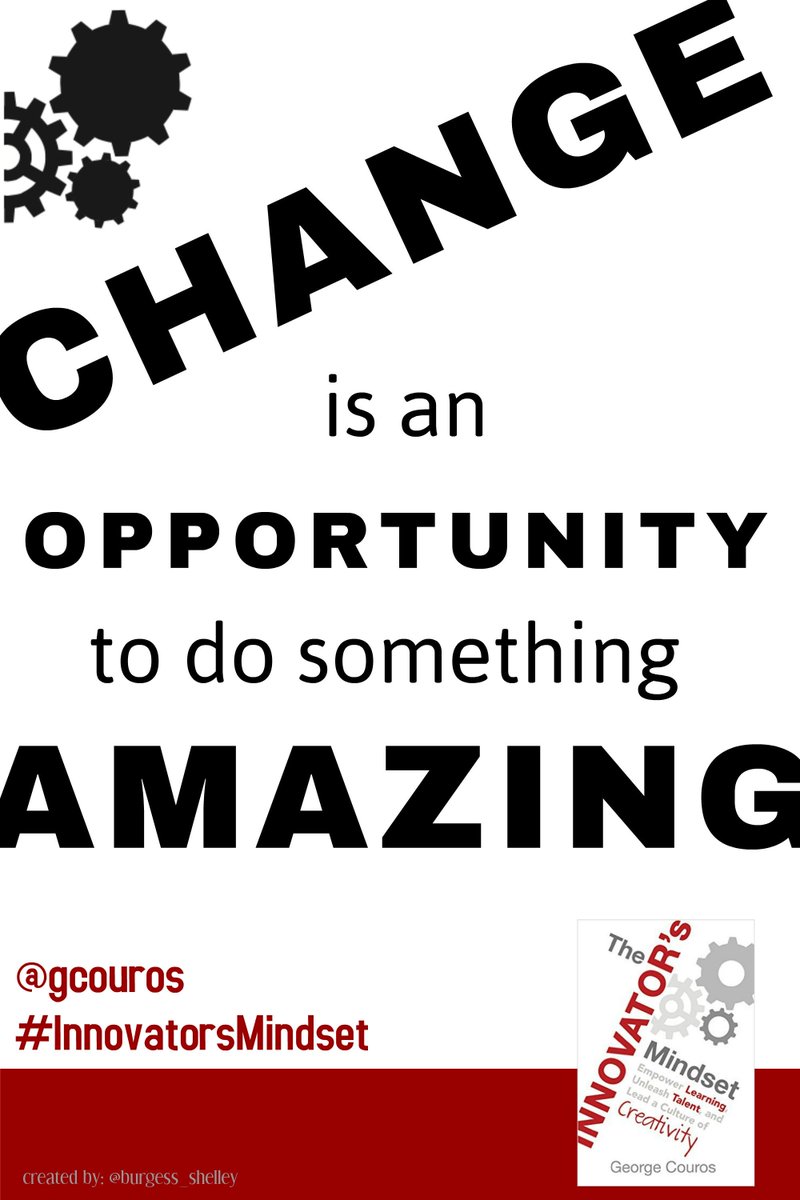
Change is an Opportunity to Do Something Amazing...All Around #IMMOOC

I have taught and read the Innovator's Mindset several times. I read it the first time for me, the second time for a book study for my school district's Innovation Teams, a third time through the lens of a pre-service teacher when I assigned it to my University of WI - Oshkosh students, and now again for the #IMMOOC book study. I have reflected on it repeatedly, blogged about it quite a few times, and have had/participated in multiple book studies on it, recommended it to hundreds of people. In all these discussions, the quote that seems to resonate with the most people is always:

Image result for change is an opportunity to do something amazing

It's easy to apply this quote to education. Our world in EDU is constantly changing. New roles are created, new curriculum is adopted, new technologies are being introduced all the time. Our world is practically fluid, rarely do things stay the same. For some, these changes in education are expected and while not always embraced, they are at least accepted. For others, change is a difficult and stressful time. The quote resonates with people because it takes the constantly fluidity of education and puts a positive spin on it. We are perpetually changing, and with that change, you can either fight it or take it as an opportunity and run with it. In that case, it's hard to imagine anyone not choosing to be amazing.

As another semester of my UWO students started and we were discussing the beginning of the book, and one student said, "I like this quote because I think it doesn't only apply to education and our jobs, but applies to our whole lives. We are in college. We've experienced big changes in our lives when we came here, and we can choose to do something amazing with our experience." I have been reflecting on what she said since that class, and it's true. Students in college are expected to make big decisions that will affect their lives forever. I remember George telling a story in one of his keynotes about a student who said she was expected to go out and change the world when she left for college, but shortly before that she had to raise her hand to go to the bathroom when she was in high school. It's a big change when you go from the constraints of high school to the openness of college, and the change is definitely a choice and an opportunity to do something amazing.

I've experienced this myself recently with taking my new position as Director of Innovation & Technology. And as much as I love my new position, there have absolutely been moments when I've felt like the amazing part of the change might not come, or "Who am I to think that I can do something amazing at all?". Change in any form is hard, and to convince yourself to do something amazing with that change can be even harder. I think about friends who are going through tough times personally: job changes, divorce, financial trouble, and it's possible that this quote might be able to be applied to all of that. In any of these cases, including in the classroom, the work related changes, the college student, the job change, the personal issues...the amazing part of the change is going to take some work.  It's probably not going to be a lightbulb moment or some epiphany where you think, "Ahhhh...there's the amazing!" but rather something that takes diligence and commitment, hard work and motivation, which can be the hardest to muster during difficult times. I think that remembering great quotes like these help us work through those changes in order to find the amazing, which brings me back to another one of my favorite quotes, and I think these two go hand-in-hand:
Image result for not telling you easy worth it


Saturday, September 3, 2016

Us vs Them on #satchatwc

It always amazes me how a single comment on Twitter can bring on a blog post.

This morning I woke up and did what I do almost every Saturday morning...I got myself a cup of coffee and sat down to read through Twitter posts. The chat #satchatwc was going on, and the participants are some of my favorite #PLN people, so I decided to jump in and attempt to catch up. The theme was "Us vs Them" and the discussion questions revolved around how we recognize this kind of behavior and ultimately stop it. Us vs them involves any groups of people where it's possible that they are not on the same page to support student learning. This could be parents vs teachers, teachers vs admin, or even teachers vs teachers.

If you haven't participated in a Twitter chat, it's amazing how when you're in the right one with the right people, your mind can be swimming with ideas and realizations by the end. Sometimes all it takes is one tweet. In this case, the tweet was this one that involved Dr. Clint Freeman & one of my favorite people, Shelley Burgess:


The part of Clint's tweet that resonated with me was the idea that the contributor to an us vs them mentality is the lens from which we view what happens around us...our perspective. Since I've entered education, I have been fortunate enough to be able to look through many different lenses. It has given me perspective that other people may not have. My first job was as a Family and Consumer Science teacher in middle school. During that time, I would have categorized the role I had as a teacher vs teacher. I often felt like the grade level teachers thought I "only" taught FACE while they did the "real" work. Not all teachers feel this way, but in the school I worked in at the time, this was the climate. I also worked as an elementary teacher, an instructional support teacher, and finally, my newest position in admin. I would say that in every position at every level, there was the feeling of an us vs them. The only thing that changed was who the "them" was.

It took me less than a month to experience this difference in perspective in my current position. The other day, a teacher said to me, "So, how do I go about getting a cushy office job like yours?" to which I had to choose between several responses that went through my head. I could have responded by telling that teacher that I was only running through the teacher's lounge in order to get to the office copier, eating a granola bar for my lunch after getting up at 4:15am for the last month in order to get to work early, or how I hadn't seen my kids three days out of the previous week because I had left before they got up in the morning and came home from work after they went to bed, or I could have told him that when I finally did make it to bed, I collapsed in exhaustion but would still wake up at 3:11am thinking about everything I couldn't get done in a day. But, I didn't. I wasn't about to perpetuate any kind of preconceived notions he had about administration, nor would it have done anything for the relationships and trust I have been trying to cultivate during the first month in my position. So, I smiled and kept walking. Plus, my guess is that there have been times he's done this same thing for his students.

Was that the right response? I have no idea. Some people think that admins should have all the answers. The truth is: I'm just trying to do the best I can for the teachers and students I serve. Just like everyone else in education.

As an Technology Integrator, people would often come up to me while I was working on my computer and start conversations with, "While you're not doing anything...". What they didn't understand was that I was making a quick instructional video or creating PD for teachers or researching an educational technology tool for a teacher, but their perspective was that I wasn't really working because I was on my computer. That's ok, it was their perspective. What I've found as I've moved positions is that this kind of thing comes from not understanding what another person does in a day. Teachers, without a doubt, have the craziest days. So many kids, so many standardized tests, so little time to go to the bathroom...but in every position I have experienced days where I wasn't really sure I'd make it through the day with my sanity. Sometimes, it's just a different kind of crazy busy. 

I believe that where we begin to misunderstand each other is when major decisions are made where all the information isn't available to everyone and there isn't a culture where trust has been established. I have already made decisions that have not been popular. The hardest decisions usually aren't. I try to let the question, "Is it supporting student learning" to guide me, and there are factors where sometimes what's happening absolutely does not support student learning. Not everyone always understands these factors, though, and it's not that I'm not willing to be transparent, and I will always provide anyone with the why behind my decisions, but rather that we need to start trusting each other to be professionals and make the best decisions for students. If that trust is broken, then that builds on the us vs them mentality. So, as usual, my conclusion is that, like everything else, the us vs them mentality begins and ends with relationships (or a lack thereof) and trust. The best way to develop empathy is to actually walk in a position's shoes, but second to that is building a culture where all "groups" have faith in each other's decisions. As an admin specifically, if you've built trust in staff by being consistent in decision-making (all decisions are guided by the mission, vision, and what's best for all learners), being visible and involved in classrooms, and knowing staff both personally and professionally, they don't need to have walked a day in your shoes in order to trust your decisions. They are more likely to trust in you, and in turn your decisions, and hopefully that reduces (if not eliminates) the Us vs Them mentality.


Saturday, June 4, 2016

How Do We Change Teachers' Perceptions of PD?

Last school year, I came up with the idea of creating a Google Apps for Education "Track". Instead of teachers attending one hour sessions on a specific Google App, myself and another Technology Integrator, Matt Callahan, developed a course in Canvas, our LMS, that covered eight of the Google Apps. In each module there are skill based lessons, examples of integration, discussion boards, formative assessments, professional readings on integration and innovation, and finally, a summative assessment that requires the teacher to take something they learned and implement it in the classroom, and then create a 3-5 minute video reflecting on how it went. In each discussion board and for each assessment, there are also choices as to questions to answer or activities to do, and each one is leveled (a beginner, intermediate, and advanced). Teachers are asked to challenge themselves in these areas, but ultimately which questions they answer and which assessment they complete is up to them. We work on district points, so the track is worth a significant number of points for completion toward their yearly goal. Teachers could choose to take it fully online or attend monthly one hour sessions where myself and Matt taught the module and supported the learning that needed to be done.

This track has, without a doubt, become my baby. I love it like I love my own children, and because of that, I am very protective of it. A requirement of joining the track was that it was all or nothing. Teachers needed to finish the whole track in order to earn all the points. When we were previously providing the hour long PD on GAFE, teachers were not attending all of the offerings. So, what was happening was we would have a teacher in a Slides PD that wouldn't know how to create a group in Gmail to easily share the Slides with their students because they never attended the Gmail PD. In order to increase capacity in this area, I felt like the entire track needed to be completed in order to really get a depth of knowledge on  GAFE and the integration into the classroom.

Overall, we have had an insane amount of positive feedback. I have been surprised multiple times by teachers searching me out to tell me how much they learned and enjoyed the track. However, even with the positive feedback, there was always a "but...". I truly dislike buts because they often negate the positive that was just heard. I often think about this quote by G. Couros, and even though I know it means in education in general, I like to apply it to my own thinking as well. The positives in my head need to outweigh the negatives that are often rolling around in there. Something I'm working on. But what bothered me was that the negatives for the track were nothing we were willing to change because it erased the best practices we were tried so hard to include in the learning. It really wasn't about what needed to be changed to be better PD. It was about what needed to change to make it "easier" or "faster". These were the kind of comments I've received:

"I learned a ton but it took me way longer than it should have."
"Why do we need discussion boards? It seems useless to need to talk to other people about this."
"I don't want to do the final reflection. Is it a requirement?"
"If I just finish five modules, can I get five points?" (which my answer was no, it defeated the purpose of the track)
"I attend the face to face monthly meetings. How many can I miss and still get my points?"

Let me be clear: I am all for feedback, and we have taken constructive feedback on the track and made changes for another upcoming enrollment. So, I take all feedback very seriously.

At first, I took some of these comments as a direct reflection on the track's setup  and implementation, but after reading the post on edSurge Why Good Professional Development is Crucially Linked to an Educator's Attitude, I started to reflect and I came to a conclusion that some of the comments may not be as linked to the track as it is to educator's attitude toward PD in general.

Every single teacher in the track (and we had 120 teachers out of 800 in the district take the track for the first year) felt like they learned a lot and the track was worth their time. Even the ones that complained it took too long still felt like they learned a ton. Part of the problem, however, is that points are mandated by our district. Teachers feel like they now must participate in PD in order to move up on the pay scale and remain a "teacher in good standing". And, we all know what happens when we create a situation where people must comply with an initiative...all of a sudden it becomes work when prior to that they would have done it before for their own professional learning. Teachers are becoming disillusioned with PD because they must comply with the points initiative. Now, I'm not saying that I know a better way to implement the system...I'm just saying that this has been a side effect.

I also feel like the type of PD that we had been offering, myself included, was mostly sit-and-get one-size-fits-all learning. Since I've become more aware and fully subscribe the the idea of personalized PD, my PD has improved, but we have still conditioned teachers to feel like their time, opinion, and learning is not going to be valued when they attend professional development, so we are now fighting that battle as well. When teachers leave a PD that has been valuable to them, they can take something back to their classroom and implement it immediately, and they are excited about what they learned...this shouldn't be something that is a pleasant surprise to them. This should be the norm, but this is the attitude that we have cultivated by not allowing for teacher voice and choice in their learning, and now it is shown in the attitude toward PD.

What I think is ultimately happening with most teachers in the track is that they enjoyed learning and becoming a "master" at GAFE, but because it's PD, they don't think they should like it. Last night we watched a guy put a meat hook through his nose on America's Got Talent. I think it's similar to watching something like that...you can't take your eyes off from it because it's exciting, but you know you shouldn't enjoy it. Most teachers commented positively about their learning, the choices they were given throughout the track, and how they now feel more comfortable with their Chromebooks and implementing GAFE in the classroom. As we become more aware of our professional development and how to personalize it to teacher needs, I am hopeful that the attitude will change to the acceptance that PD can be something we celebrate as an indication of professional learning and growth, rather than work we need to do as a part of our job.

Tuesday, May 3, 2016

Adjunct Teaching

Sometime last December an opportunity to teach at the University of Oshkosh literally fell into my lap. The professor for the one and only instructional technology course for students in the college of education was going on sabbatical, and the school was looking for adjuncts to pick up her classes. I applied. I interviewed. I was offered two sections on the spot. It was truly something I had wanted to do since entering into the field of education, so I was beyond excited for the opportunity.

I began planning immediately. I tried to think of what my professors had done that I really liked when I was in college. They:

  • made me feel as though they cared and formed relationships
  • gave me practical knowledge as well as theory
  • remembered that we all had lives outside of school (I happened to have 3 kids while finishing my bachelors)
  • made me laugh
  • told me stories
  • challenged me to think differently
And I tried to remember what I didn't like:
  • when they were super unorganized (I had a prof that wore her button-up shirt inside out once)
  • the work seemed like it was designed only to keep me busy
  • they lectured - all. the. time
  • there was no "give" to their methods (due dates were due dates no matter what, how I showed my learning was nonnegotiable, etc)
  • they clearly didn't care
I also thought about my experiences in the professional development that I provide to teachers, and how I have been working toward providing PD that is more personalized and that has voice, choice and pacing options. I wanted that for my students as well because I wanted to model that type of classroom environment and learning. I wanted to model innovative thinking. I wanted to show the importance of making connections.

In true "first year teacher fashion", I'm not sure how much of this I did. My good intentions were definitely there. We read the Innovator's Mindset by George Couros (clearly I have an affinity for this book). I tried to come up with innovative ways for students to do their weekly reflections/discussions on the chapters. We did EDUin30 videos, group discussions, a Twitter chat, used Padlet...I wracked my brain trying to think of different ways. We connected with Jen Hegna and her Innovation Cohort of grad students twice during the semester to grow our PLN and learn the importance of being connected. I gave choice in their assessments and modeled using rubrics to allow for that choice. Once they figured out that they could actually be creative in their assessments, mainly in our very last Innovator's Mindset reflection, what they turned in was amazing. Certainly beyond my expectations. Every. Single. One. 

Still, I feel like I could have done more.

Now that it's the last two weeks of the semester, it has really hit me that the two classes I had this semester are the equivalent of the first class that I ever taught in middle school and then again in the first class I taught in elementary, I am going to MISS them. Every single Monday and Wednesday I laughed, had moments of teacher pride and saw many of them grow in their thinking. Sometimes I caught them rolling their eyes at me, but hey, there are times I'd roll my eyes at myself, too. One of the reasons I love being a technology coach is because I feel like I can reach so many more students by working with their teachers, even if I don't do it directly. I feel the same way about teaching students who will one day be teachers, and on the way I also figured out that college students are phenomenal people. When you allow them, they love to laugh and have fun while they learn. They still can have a creative side when you allow them. They will challenge themselves as evidenced by some of their EDUin30 videos and how they posted them on Twitter (SO proud of them for that-see examples here). Sometimes I think we spend so much time labeling people with their generation and focusing on what they don't do that we forget to remember the awesome people that they are and focus on their strengths. In the past, I have been guilty of this as well. Overall, I have learned that it is possible to love students after 14 weeks, and teaching these courses might be one of the most important jobs of my career.


I highly recommend, if given the chance, to give being an adjunct a try. It is a truly rewarding experience. When you do, I hope you have someone like my friend Brian Bartel, who is a tech integrator like me by day and an adjunct by night, who answered every one of my questions. All 1001 of them. At least twice (I suspect he's just copying and pasting answers to me now). Thanks Brian! :)

Monday, April 25, 2016

Implementation of Innovation Teams

The 2015-2016 school year was my first year as a Technology Integrator. When I first began, both the position and I were new to the district. My understanding when I started was that some schools had "Tech Teams" and some didn't, and even the ones that did couldn't really tell me what the purpose was. Until I could get a handle on what was happening in the schools in regards to technology and innovation, I decided to hold off on beginning any kind of team.

This year, following in one of our high school's footsteps, I decided to start teams that focused on personalized learning and different innovative s, and I called our teams Innovation Teams. Currently, I am the Technology Integrator at three elementary schools, and each school has teachers and administrators that are a part of the team (one team, three schools). Teachers are on the team on a completely voluntary basis, and they are receiving no additional compensation of any kind for their extra work. Everything they do is to make themselves better for their students and profession, and I am super proud and humbled to be working with such a dedicated group of educators.

We began with a book study on what I knew to be a fantastic read in The Innovator's Mindset by George Couros. I've read the book multiple times, as well as assigned it as a class textbook for my UWO class, and I strongly felt that the mindset that the book describes was exactly what I wanted my Innovation Teams to embrace. We are almost done with the book, and there have been many ahas and that's-what-I-was-thinkings along the way. I think that the idea of being open to new experiences, the characteristics of the Innovator's Mindset, discussing an innovator's mindset versus growth mindset versus fixed mindset versus a false growth mindset has been eye opening and has set the teachers on a self-reflective journey prior to really digging in to what we wanted to accomplish.

Once the book study was underway, we also pulled up articles and research on Flexible Learning Spaces, how to create one, what to expect from students, and the benefits of implementing them. For me, I felt like Flexible Learning Spaces was a fantastic way to create teacher buy-in. Considering I was a former elementary teacher, I knew that I gravitated toward initiatives that I could both see and that would make a difference in my classroom immediately if not sooner. My thoughts were that studying and implementing Flexible Learning Spaces would hit both of these targets. In order to allow for the purchasing of flexible seating options, each principal in my three schools decided to pitch in some funds for purchasing, and each teacher put their classroom up on GoFundMe to get additional monies. There was a variety of success, but all Innovation Team teachers have made modifications to their classroom in various degrees. Some of the teachers who have made the biggest changes have plans to blog on their new classrooms and successes in our new collaborative blog: Teaching, Learning & Innovation.

As teachers began working on their classroom design and figuring out what works for their students, we also began looking at personalized learning and what it means for students to have voice and choice in their learning. We have decided to put pacing on the back-burner for now since set school schedules don't allow for as many pacing options in elementary, not that we can't get there eventually, but voice and choice are easier to implement within the elementary curriculum. Currently, we are implementing the practice of creating a rubric with standards and allowing for choice based on the rubric. Our goal is to create more authentic learning experiences for the students. We are working our way there.

In one school, we implemented our version of a student led edcamp, which we plan on doing again with some tweaks to make it more edcamp-like. We are also looking into Genius Hour and what that looks like in elementary. Each of the Innovation Team's teachers have gravitated toward a different part of what we have studied, but they are all moving forward. What has happened is that we are ending up with teachers who have become "experts" in different areas and it will allow our team to be stronger as everyone brings something different to the table.

I knew when I began the Innovation Teams that there were pockets of innovation and elements of personalized learning already going on in classrooms. I by no means think that I have brought innovative thinking to these teachers, but rather have put them together in order for them to feed off from each other and grow. I just provide them the support they need to move forward and the resources that challenge their thinking. My hope is that once others see what these teachers have accomplished (and in a relatively short period of time!) there will be a shift in thinking and we will be working toward a culture of innovation where innovation and personalized learning aren't the exception or a special occurrence, but happen everyday and will be known instead as simply learning.